



Setting up in Venezuela: opportunities, risks and steps
A guide for companies looking to set up in Venezuela: opportunities, local partners, risks and steps to develop a real business project.
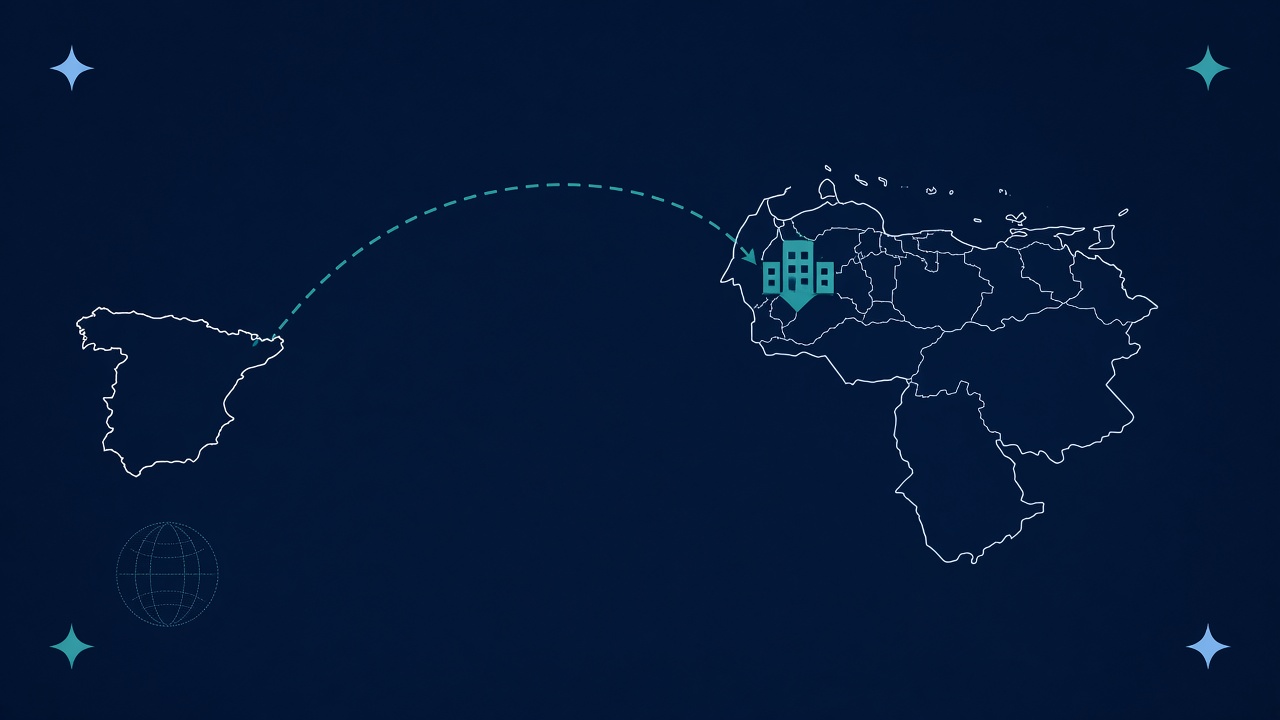
Venezuela is back on the agenda of international companies looking at new markets, production, distribution and investment. Spotting an opportunity and turning it into a viable business, however, are two very different things.
For a company considering setting up in Venezuela, the question should not be only “what can we sell there?”. It is what need exists, who can buy, how the operation will be executed, and what conditions must be in place for the project to be sustainable.
At Unicornio Azul we approach international business development with one premise: before committing significant resources, possibilities have to become verified information, the right contacts and an execution plan.
Spotting an opportunity and turning it into a viable business are two very different things.
Why some companies are looking at Venezuela again
The country has natural resources, a historic industrial base, a population with consumer needs and a substantial business diaspora. There is also the possibility of recovering productive capacity and services that have suffered years of economic difficulty.
In 2026 there have been relevant moves in the energy sector and changes in the international authorisations framework. These developments should not be read as a general opening of every sector, nor as a guarantee of legal certainty. Each project needs its activity, counterparties, financing and applicable rules assessed.
Business interest may exist, but a real opportunity depends on demand, ability to pay and the possibility of operating on an ongoing basis.
Five entry routes a company can study
1. Export and commercial distribution
This is one of the least capital-intensive formulas at the outset. It allows you to test product acceptance, build a commercial network and understand market conditions before setting up your own structure.
The critical point is choosing the distributor correctly. A company with contacts does not necessarily have commercial coverage, financial capacity, warehousing or category experience. Its activity, references and payment terms need to be verified.
2. Industrial presence and local production
Recovering or creating productive capacity can open opportunities for manufacturers that bring machinery, engineering, technology, processes and technical know-how.
One possible model is to combine international technology with local resources, facilities, people and market access. Before considering an investment, however, power supply, raw-material availability, permits, asset ownership and economic viability must be checked.
The existence of an available factory or a plot of land is not, by itself, a viable industrial project.
3. Supply of machinery and equipment
Companies specialised in capital goods may find opportunities in industrial renewal, food processing, construction, logistics and other productive sectors.
Competitive advantage should not be limited to selling the machine. Installation, training, spare parts, maintenance and technical support can be decisive for the client to get results and to build a lasting commercial relationship.
4. Alliances with local companies
An alliance can provide market knowledge, commercial relationships, infrastructure and operational execution. It can also reduce some of the cost of entry.
Choosing the partner, however, is one of the highest-risk decisions. Shareholders, ultimate beneficial owners, financial position, experience and possible contingencies need to be identified. Personal references are useful to start conversations; they do not replace a documentary review.
5. Specialised services and project development
Engineering, international sourcing, logistics, technology, consulting and B2B services can take part in projects without initially committing to an industrial investment of their own.
In these cases, the value lies in solving a concrete need and clearly defining scope, deliverables, responsibilities and the collection mechanism.
The local partner: a decision that cannot rest on trust alone
In complex markets, a local counterpart can be a significant advantage. A good personal relationship, however, is not the same as a business assessment.
Before entering a meaningful collaboration it is worth checking the company’s legal existence, shareholding, powers of representation, commercial activity, facilities and references from customers and suppliers. When the operation justifies it, financial information should also be requested, along with legal and compliance checks.
The aim is not to distrust every company. It is to distinguish a promising commercial relationship from a counterpart verified enough to take on commitments.
Risks that must be analysed before investing
Legal certainty and regulation
Corporate structure, permits, the tax regime and contractual terms should be reviewed by local professionals. In certain sectors there may be specific requirements or involvement of public bodies.
International sanctions must also be analysed according to the activity, the people involved, the origin of the goods and the financial channels. OFAC authorisations have changed during 2026, so it is not prudent to rely on outdated information or to assume that a licence covers any operation.
Financing and collections
An operation that looks profitable on paper can stop being so if there is no verifiable collection mechanism. Currency, bank, guarantees, advances and payment terms need to be defined before shipping goods or committing investment.
Logistics and infrastructure
Transport, customs, warehousing, energy, communications and maintenance costs must form part of the economic calculation. In industrial projects, the real availability of electricity and other services is an essential condition, not a later detail.
Execution risk
Missing spare parts, a delayed installation, a defaulting supplier or a counterpart without operational capacity can compromise the outcome. Projects therefore need milestones, owners, budgets and follow-up mechanisms.
How to go from an idea to a real presence
At Unicornio Azul we treat internationalisation as a process of progressive validation, not as a decision based on intuition alone.
First, identify the opportunity. Analyse the market need, the target customer and the value proposition. Not every product or model that works in Spain is suitable for Venezuela.
Second, test the market. Speak with buyers, distributors, operators and potential partners to check prices, demand, competition and real conditions.
Third, design the entry model. Export, representation, alliance, local production or direct investment should be compared according to resources, risks and objectives.
Fourth, verify counterparties. A business and documentary review helps reduce the risk of committing resources to the wrong partners.
Fifth, build the project. Develop budgets, suppliers, logistics, financing, timeline and responsibilities, setting the conditions needed to execute.
This approach makes it possible to move in phases and avoid an attractive opportunity turning into an investment that is hard to control.
Unicornio Azul’s role in business development
Unicornio Azul works at the connection between strategy and execution. Our experience in international sourcing, commercial development and marketing lets us approach projects from several angles: identifying opportunities, locating suppliers, analysing counterparties, structuring proposals and coordinating the steps needed to develop an operation.
In Venezuela, the approach is to combine international knowledge with information gathered on the ground and verified business relationships. Each project needs a specific analysis; there is no single formula for every sector.
Our aim is not to promise results or present the market as an opportunity without risk, but to help companies make better-founded decisions and move towards concrete projects.
Is your company ready to set up in Venezuela?
Before starting an operation, four questions are worth answering: is there identified demand? Do we have a reliable counterpart? Do we know the real cost of executing the project? And do we have an adequate collection system and legal structure?
If any of these answers is still unclear, the next step should not be to invest, but to investigate and validate.
Are you considering exporting, developing an alliance or setting up a business activity in Venezuela? At Unicornio Azul we can help you study the opportunity, identify the resources required and define a roadmap adapted to your project.
Learn about Unicornio Azul and get in touch to discuss your proposal.
Informational article updated in September 2026. It does not constitute legal, tax or financial advice, nor a guarantee of viability. Regulatory and commercial conditions must be verified for each operation.
By Luis Chicharro
Shall we talk about your project?
If you are working on something similar, tell us about it and we will look at it from real experience, not theory.